
Storm Damage to Grain Bins and Farm Buildings: What to Do in the First 30 Days
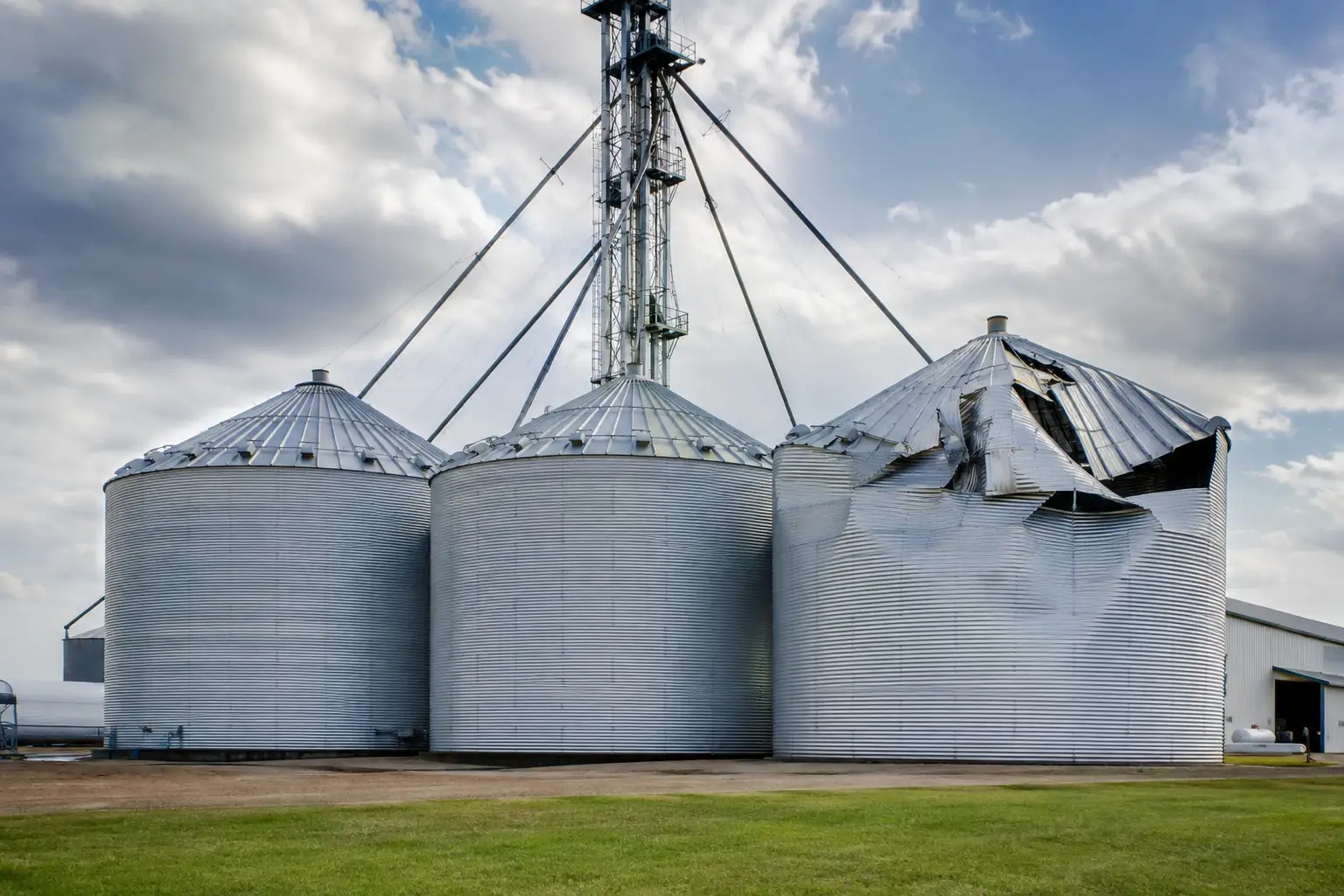
When a storm takes out a grain bin or a machine shed, the damage is the easy part to see. The part that costs you is the calendar.
Between the claim, the estimate, the order and the build, a rebuild takes longer than most operations expect — and the clock is running against harvest, not against your insurance company. What you do in the first few days determines whether you're storing your own crop this fall or paying someone else to.
Here's the sequence that keeps a rebuild on schedule.
Document before you clear
The instinct after a storm is to start cleaning up. Resist it for a day.
Once debris is moved, the evidence of what happened moves with it — and you'll be asked to prove both what was there and how it failed. Before anything gets hauled off:
- Photograph wide, then close. Wide shots establish the whole structure and its position. Close shots show the failure points — sheared bolts, buckled sheeting, foundation separation.
- Get the data plates. Manufacturer, model, capacity and serial number on bins, dryers, fans and handling equipment. This is the single most common gap, and without it you're negotiating capacity and specification from memory.
- Capture what was inside. Stored grain, equipment, inputs. Contents are frequently a separate line on the claim from the structure.
- Note the date and time. If more than one weather event moved through, which storm did what becomes a real question later.
If you've already cleared, it isn't fatal — but tell your adjuster up front rather than letting it surface as a discrepancy.
Understand what your policy actually pays
This is where operations lose the most money, and it's usually discovered late.
Replacement cost pays what it takes to rebuild at today's prices. Actual cash value pays what the structure was worth after depreciation — which on a thirty-year-old bin can be a fraction of what replacing it costs. The two produce very different numbers on the same loss.
Find out which you have before you plan the rebuild, not after. Also worth confirming:
- Whether code upgrades are covered. A structure built decades ago may not be permitted to be rebuilt to its original spec, and the gap between old and current code is a real cost.
- Whether you carry business interruption or extra expense coverage that would offset the cost of trucking and storing grain elsewhere this fall.
- Your deductible structure — some farm policies apply a percentage deductible to wind and hail rather than a flat amount.
Get the scope of loss in writing
Your adjuster will produce a scope of loss — the itemized list of what's damaged and what it takes to repair or replace it. Get a copy.
That document is what your builder prices against. Without it, you get an estimate built on assumptions, then a second round of negotiation when the two don't line up. With it, the estimate and the claim speak the same language from the start, and the claim moves.
If the scope looks thin to you, say so early. It is far easier to have an item added during the initial review than to reopen a settled claim.
Get your estimate in the format the claim needs
An estimate that says “grain bin replacement — $X” invites questions. An estimate broken into foundation, structure, flooring, aeration, controls, electrical and site work answers them.
Line-item detail is not paperwork for its own sake. It's what lets an adjuster approve a claim without sending it back for more information, and returned claims are where weeks disappear.
Get more than one estimate. Compare them on what's actually included — site prep, concrete, removal and disposal of the damaged structure, electrical reconnection — not just the number at the bottom. Those items don't vanish because they weren't quoted; they arrive later as change orders.
Expect the schedule, not the price, to be the constraint
After a widespread storm, two things happen at once in the affected area. Every operation that took damage starts calling the same builders, and lead times on steel and components stretch as regional demand spikes.
Capacity books in the order people commit, not in the order they were damaged. The operations that are back at full capacity before harvest are consistently the ones that started the conversation early — often before the claim was fully settled.
You don't have to have every number finalized to get on a schedule. You do have to be in line.
What you can decide now
Some decisions don't need to wait for the claim:
- Rebuild in place or relocate. If a bin site has always been awkward for truck traffic or too close to a road, a rebuild is the cheapest chance you'll ever have to move it.
- Same capacity or more. Rebuilding to the original specification is the default, not the requirement. If your operation has grown into its storage, this is the moment to size for where you actually are.
- What to consolidate. Several small structures lost in one event sometimes rebuild better as one.
These are worth thinking about now, because they change the estimate — and it's cheaper to decide before the drawings than after.
Jensen Builders Ltd.
We've been building agricultural structures across Iowa for forty years — grain bins and handling systems, machine sheds, livestock buildings, shops and pole barns, along with the foundations, concrete and site work underneath them.
We'll walk the damage with you, document what's there, and put together an estimate in the format your adjuster needs. If your adjuster has already been out, bring us the scope of loss and we'll price against it.
An estimate costs nothing and holds your place in the schedule.